
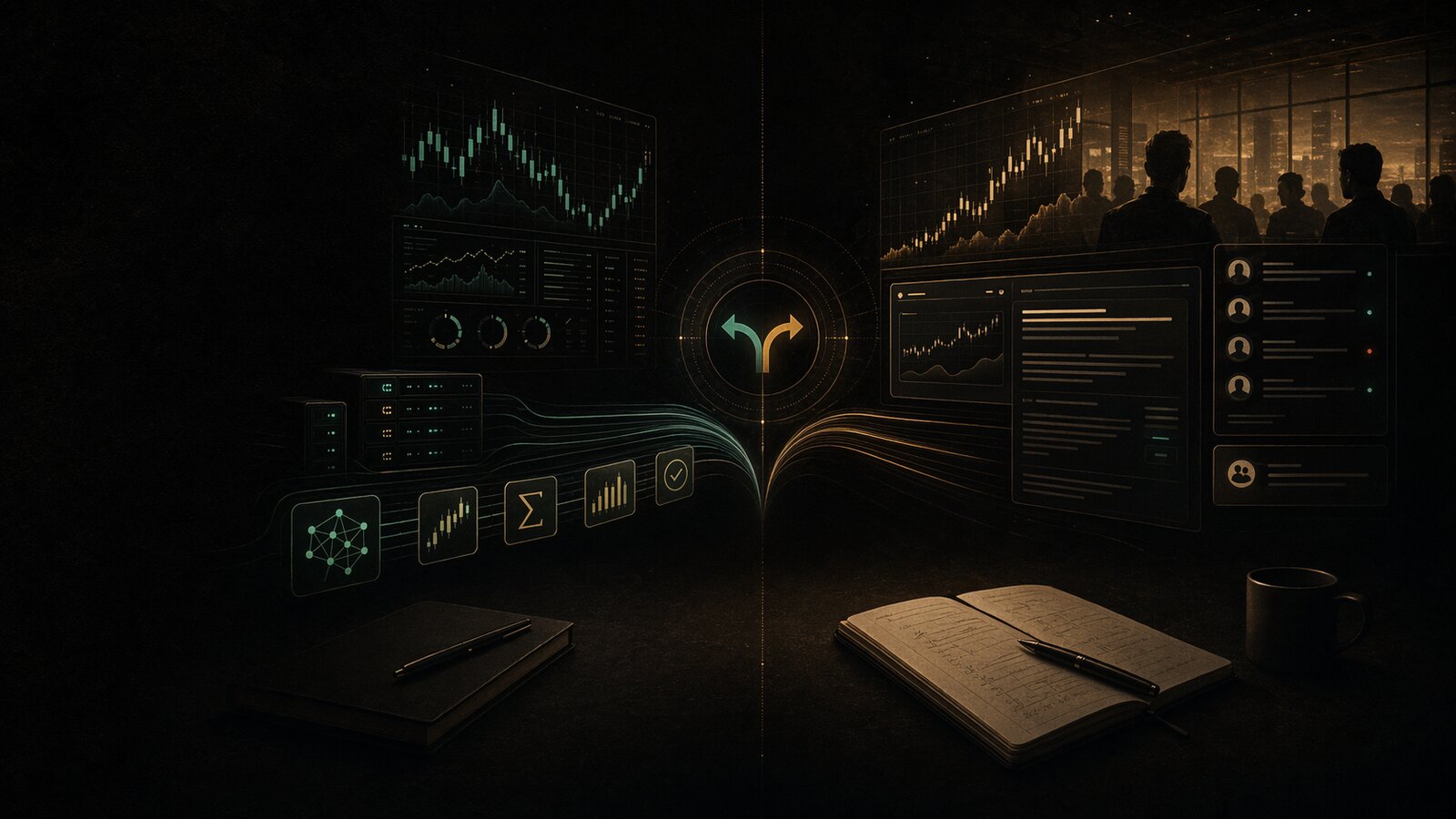
If you’re trying to take your crypto trading seriously, sooner or later you run into this fork in the road:
Path A: Subscribe to an AI trading bot. Connect it to your exchange. Let it trade automatically while you sleep.
Path B: Join a signal group — usually on Discord or Telegram — where AI + human analysts post trade setups that you execute yourself, inside a community of other traders.
Both paths are legitimate. Both have produced winning traders and bankrupt ones. And both are marketed to you by a cottage industry of YouTube affiliates with a strong incentive to convince you that their favorite platform is the only correct choice.
This article is not going to do that. We’re going to walk through both options honestly — the math, the hidden costs, the failure modes, and the specific type of trader each one actually suits. We’ll also tell you which one Ascendant Traders is (spoiler: signal group) and why, despite the name on the website, the honest answer to “which is better” is “it depends — here’s how to decide.”
Let’s get into it.
⚠️ Upfront disclaimer: Everything in this article is educational. None of it is financial advice. Crypto trading — automated or manual — carries substantial risk of loss. Always trade with capital you can afford to lose completely, and always read the terms before connecting any third-party service to your exchange.
§1 — What Exactly Is an AI Crypto Trading Bot?
The term “AI trading bot” has been stretched so thin in 2026 marketing that it needs unpacking before we compare anything.
At its core, an AI crypto trading bot is software that:
- Connects to your exchange via API
- Monitors live market data (prices, volume, order book depth)
- Applies some set of rules — basic or sophisticated — to decide when to open and close positions
- Executes those decisions automatically, without you pressing any buttons
The “AI” part is where the marketing gets loose. In practice, commercial crypto bots fall into three tiers:
Tier 1 — Rule-based bots (not really AI)
These bots follow deterministic logic. “If RSI drops below 30, buy. If price rises 2% above entry, sell.” Grid bots, DCA (dollar-cost-averaging) bots, and martingale bots all live here. They are useful, proven tools — but they are not intelligent. They’re calculators with triggers.
Examples: Pionex grid bots, 3Commas DCA bots, most Binance built-in bot strategies.
Tier 2 — Machine-learning-assisted bots
These bots use ML models for specific sub-tasks: parameter optimization (“what grid spacing fits current volatility?”), sentiment classification (“is Twitter bullish or bearish on ETH right now?”), or signal filtering (“does this setup match patterns that historically won?”). The ML is real, but it’s layered on top of traditional rule-based execution.
Examples: 3Commas AI add-ons, Cryptohopper’s algorithm intelligence, Dash2Trade.
Tier 3 — True AI-driven quant systems
These bots use deep learning models to generate trading decisions end-to-end. They train on large proprietary datasets, incorporate multiple data streams (on-chain, order flow, sentiment, macro), and continuously retrain as market conditions shift. They also cost real money to build — usually $10M+ in development — and are rarely offered to retail at accessible prices.
Examples: Institutional platforms like SaintQuant, Numerai, and some hedge-fund-flavored retail offerings.
When a marketing page says “AI-powered bot” without specifying which tier, assume Tier 1 or Tier 2 until proven otherwise. Tier 3 platforms are proud of their approach and explain it in detail. If the “AI” feels vague, it probably is.
§2 — What Exactly Is a Crypto Signal Group?
A signal group is a community — usually hosted on Discord or Telegram — where trade setups are posted for members to follow manually. The community around the signals is part of the product: education, chat, Q&A with analysts, discussions of wins and losses, shared psychology.
Signal groups come in two flavors:
Flavor A — Pure human analyst groups
A team of traders watches the market, writes trade setups, and posts them. Quality depends entirely on who’s holding the pen that day. Can range from outstanding (veteran traders with decade-plus track records) to dogshit (a 22-year-old with a Twitter account).
Examples: Most small-scale paid Telegram groups.
Flavor B — Hybrid AI + human groups
AI systems scan markets continuously and generate candidate signals. Human analysts review, filter, and publish the ones that meet confluence criteria. The AI handles the scanning (a job humans can’t do 24/7); the humans handle judgment and context.
Examples: Ascendant Traders, The Crypto Sanctuary, Dash2Trade’s community tier.
The key structural difference
In both flavors, you execute the trade yourself. The signal group tells you what, when, and why. You decide whether to take it, what leverage, what size, and when to exit. Your money stays on your exchange, in your account, under your keys, the entire time.
That structural difference is the main thing separating signal groups from bots — and it drives most of the pros and cons we’re about to discuss.
§3 — The Honest Pro/Con Breakdown
AI Trading Bots: Pros
1. Genuinely hands-off
If configured correctly, a bot trades while you sleep, work, or vacation. You don’t need to watch charts, read signals, or make manual decisions. For people with full-time jobs and no time to trade actively, this is huge.
2. Emotion-free execution
Bots don’t panic-sell. Bots don’t revenge-trade after a loss. Bots don’t hold a losing position hoping it recovers. In theory, this removes the single biggest source of retail trader destruction: their own psychology.
3. Speed
A bot places an order in milliseconds. A human reading a signal on Discord takes 30-60 seconds minimum. In scalping strategies where seconds matter, bots have a real structural edge.
4. 24/7 coverage
Crypto markets never close. A bot can capture moves that happen at 3 AM your time. A signal group (and you, the manual trader) can’t match that without sleep deprivation.
AI Trading Bots: Cons
1. Setup complexity is brutal for beginners
Configuring a grid bot’s range, a DCA bot’s intervals, or a strategy bot’s indicator thresholds requires real understanding. Miss the configuration and you’ll get a bot that perfectly executes a terrible strategy. “No-code” platforms help but don’t eliminate the problem.
2. No context, no judgment
A bot doesn’t know that the Fed is meeting in 20 minutes. A bot doesn’t know that Binance just paused withdrawals. A bot doesn’t know that the ETH foundation just announced an unlock. It sees charts; it misses reality. Unusual market conditions (flash crashes, liquidation cascades, exchange outages) are where bots either freeze, misbehave, or burn real money before you can stop them.
3. API key security risk
Connecting a bot to your exchange requires giving it API access. Done right (trading-only permissions, withdrawal disabled), this is safe. Done wrong (accidentally enabling withdrawals, using a compromised bot platform), it’s how people lose entire accounts. Several high-profile retail bot platforms have been hacked or exit-scammed.
4. Most bots lose money in sideways markets
Grid and DCA bots work best in ranging markets. Trend-following bots work best in trending markets. A bot configured for one regime gets murdered in the other. Unless the bot dynamically switches (very few do), you’ll have good months and catastrophic months.
5. Subscription + performance fees stack up
A typical AI bot platform charges $30-100/month in subscription fees, plus sometimes a percentage of profits. If your bot isn’t reliably outperforming, these fees eat your returns.
6. “AI” is often marketing
As discussed in §1, most retail “AI bots” are Tier 1 (rule-based) or Tier 2 (ML-assisted). True AI quant is expensive and institutional. Be skeptical of any retail platform promising “institutional-grade AI” at a $30/month price point.
Signal Groups: Pros
1. Human judgment at the decision point
You, the trader, are the final filter. You can skip a signal because there’s a Fed meeting in an hour. You can size down because you just took two losses and want to cool off. You can take the signal at 2x leverage instead of 5x because you’re still learning. The context that bots miss, you supply.
2. Educational compound effect
Every signal in a good group comes with setup notes. Over 100 trades, you start to recognize patterns: “oh, this kind of setup tends to work,” “that kind of setup tends to fake out.” Within 6 months, a good signal group member starts generating their own trade ideas — which is the real endgame.
3. Community accountability
When you lose, someone else in the group also lost. When you win, others celebrate with you. The community provides the psychological buffer that solo traders almost never have, which is why solo traders wash out at insane rates and community traders persist longer.
4. No API keys required
Your exchange access is never shared. Your keys, your coins. Even if the signal provider is hacked, your money isn’t touchable. This is a massive security advantage that people overlook until it matters.
5. Signals explain themselves
A good signal group shows you why a trade is being called. Over time, you learn the indicators, the reasoning, the rhythm of market phases. A bot just tells you what happened after the fact.
6. Dramatically lower subscription cost
Most premium signal groups run $20-50/month. Some are free (with paid tiers for advanced signals). Compared to a $50-100/month bot subscription plus performance fees, signal groups are often cheaper for similar-quality edge.
Signal Groups: Cons
1. You have to actually do the work
You have to open the signal, place the orders, set the stop-loss, manage the position. If you miss a signal, you miss the trade. For busy people, this is a real constraint.
2. Execution speed suffers
By the time you read the Discord notification, unlock your phone, open Blofin, and enter the trade, the entry price may have moved. This slippage erodes edge, especially on fast-moving scalps. Signal groups typically compensate by focusing on higher-timeframe setups (4H, daily) where a 30-second delay doesn’t matter.
3. Emotional trading is still possible
The signal group tells you to exit at stop-loss. You decide to “give it room.” You blow up anyway. The bot would have enforced the stop. The signal group can’t force you — it can only tell you what to do.
4. Quality varies dramatically
There are scam signal groups posting fabricated win screenshots. There are groups with real AI systems and transparent track records. Distinguishing them requires time, research, and ideally a trial period in their free tier first.
5. Language and timezone barriers
Most established signal groups operate in English, from US or European time zones. If you’re in Japan, Korea, or India, you might be getting signals at 3 AM local. Multilingual signal groups (Ascendant Traders is one) are rare but solve this.
§4 — The Math Nobody Publishes: Real Returns vs Advertised Returns
Both bot platforms and signal groups advertise returns. Almost none of them publish honest, complete math. Let’s do it ourselves.
Typical bot performance breakdown
A mid-tier AI bot running a grid strategy on BTC in 2024-2026:
- Good months: +5% to +15%
- Bad months: -10% to -30% (usually when BTC breaks the grid range)
- Average annual return: estimated +20% to +40% in neutral market conditions
- Fees to platform: $600-1,200/year subscription + 10-20% performance fee on some platforms
- Net return after fees: typically +10% to +25%
When grid bot marketing says “40% annual returns,” the honest version is “40% before fees in ideal market conditions; actual net return to you, after fees and drawdowns, is probably 15-20%.”
Typical signal group performance breakdown
A legitimate AI-hybrid signal group with a 65% winrate and 1:2 average R/R:
- Monthly breakeven point: 33% winrate (you can be wrong 2/3 of the time and still make money at 1:2 R/R)
- Expected monthly return at 1-2% risk per trade, 20-40 trades per month: +4% to +12%
- Bad months: -4% to -8% (all strategies have losing months)
- Average annual return: estimated +30% to +80% with disciplined execution
- Fees to platform: $240-600/year
- Net return after fees: typically +20% to +70% if you execute well
But — and this is the critical but — signal group returns depend enormously on your execution. If you skip stop-losses, oversize, or revenge-trade, your returns can be negative even with a 70%-winrate signal provider. The signal is 30% of the trade. Your behavior is 70%.
Bots don’t have that asymmetry. Whatever return the bot produces, you get — minus fees. Worse, but predictable.
§5 — The Hidden Costs That Nobody Talks About
Both options have costs beyond the subscription. Here’s the full picture.
Hidden costs of bots
- Downtime and missed trades when the bot platform has an outage (it happens)
- Slippage and fee creep from bots that over-trade (more trades = more exchange fees)
- Opportunity cost of capital locked in a grid that doesn’t trigger
- Research time to configure the bot properly
- Trust risk — you’re betting the platform won’t get hacked, exit-scam, or delist your exchange
- Learning loss — you’re not developing trading skill; you’re outsourcing it
Hidden costs of signal groups
- Time cost — reading every signal, placing orders, monitoring positions
- Mental tax — the emotional weight of making decisions 3-5 times per day
- FOMO — watching signals you decided to skip turn out to be winners
- Discord/Telegram noise — community chat can be distracting during actual trading hours
- Quality variance by provider — a good group is 10x better than a bad group, and the difference matters
The honest total cost comparison
For a $10,000 account, trading at modest size, over 1 year:
| Item | AI Bot | Signal Group |
|---|---|---|
| Subscription | $600-1,200 | $240-600 |
| Exchange fees | Higher (more trades) | Lower |
| Time investment | 1-2 hrs/week | 5-10 hrs/week |
| Mental load | Low | Medium |
| Learning gained | Low | High |
| Security risk | Medium (API keys) | Very low |
| Typical net return range | +10% to +25% | +15% to +45% |
| Return variance | Lower | Higher |
Signal groups usually produce higher expected returns with higher variance. Bots usually produce lower expected returns with lower variance. Which is “better” depends on whether you value expected return or variance more, and whether you can tolerate the extra time investment.
§6 — Specific Failure Modes You Should Know
How bots fail catastrophically
- Grid bot meets a one-way market: BTC falls 30% in a week, the bot keeps buying all the way down, you’re now holding a position at 50% drawdown.
- API key theft: the bot platform gets hacked, withdrawal permissions were accidentally enabled, your account drains.
- Bug in the bot logic: a rare edge case causes the bot to over-leverage or place orders at impossible prices. By the time you notice, damage is done.
- Exchange outage during volatility: bot can’t adjust positions, liquidation cascade wipes you out.
How signal groups fail catastrophically
- Provider goes rogue or gets compromised: someone gains admin access and posts malicious “signals” designed to pump their own holdings. Members who follow blindly get burned.
- Scam provider from day one: fake winrates, cherry-picked screenshots, pump-and-dump altcoin calls. Best defense is using free tiers to verify before paying.
- Your own discipline failure: you stop following stop-losses, you revenge-trade, you blow up your account. This is by far the most common failure mode for signal group members.
- Provider burns out or quits: the analyst team disappears, the Discord goes silent, you realize you paid $500/year for a ghost town.
§7 — Which Is Right for You? A Decision Framework
Here’s a crude but useful heuristic:
Pick a bot if:
- You have a full-time job and genuinely cannot be glued to a phone during the day
- You’re comfortable with API key security (2FA on, withdrawal disabled, platform vetted)
- You have some technical comfort — you can read a config screen without panicking
- You’re okay with lower average returns in exchange for truly hands-off operation
- You’ve already learned the basics of trading and just want execution automated
Pick a signal group if:
- You want to learn trading, not just automate it
- You’re willing to invest 5-10 hours a week on execution and review
- You care about community and psychological support
- You prefer keeping API access out of third-party hands
- You’re suspicious of “AI magic” marketing and want to see reasoning behind every trade
- You’re in a non-English-speaking market and want signals in your language
Pick both if:
- You have the capital and time to run parallel experiments
- You’re comfortable splitting your strategy (e.g., bot on low-risk grid, signal group on higher-conviction directional trades)
For the vast majority of beginners asking “which should I start with?” — start with a signal group, specifically one with a free tier so you can watch and learn before paying. After 3-6 months, if you’re still trading and want to scale, layer a bot on a portion of your capital. Not the other way around.
§8 — The Honest Case for Signal Groups in 2026
Ascendant Traders is a signal group. So we’re biased. We’ll try to be transparent about why we think the model is underrated in 2026.
Argument 1: The education compounds.
Every signal you follow is a lesson. Every loss is a lesson. Every skipped signal that wins is a lesson. After a year in a good signal group, most members can either identify their own setups or at least understand which signal providers to trust going forward. Bots don’t teach. They execute.
Argument 2: Human judgment still matters.
Crypto markets in 2026 are dominated by macro narratives — Fed policy, ETF flows, regulatory headlines, stablecoin events. AI bots miss these. Signal group analysts (and you) don’t. A good signal group routes around known macro landmines. A pure bot walks into them.
Argument 3: Security is often the forgotten dimension.
Every year, retail traders lose collectively tens of millions of dollars to API key compromises, bot platform hacks, and custodial failures. Signal groups don’t have this attack surface. Your coins stay on your exchange; your keys stay in your wallet.
Argument 4: Community is a moat that bots can’t match.
The psychological support of trading alongside other humans — seeing that others also took the loss, hearing someone else talk through the setup, celebrating a winning week together — is impossible to replicate with a bot. For most people, this is what keeps them trading during drawdown periods, which is when most solo traders quit.
Argument 5: Price-to-value is generally better.
For the price of a decent bot subscription ($50-100/month), you can get a top-tier signal group with community, education, and multi-language support. The marginal value per dollar is usually higher on the signal group side.
None of this means bots are bad. Bots are legitimately the right choice for certain trader profiles. But the default assumption — “AI bot = next level of trading sophistication” — is wrong. It’s a different tool for a different use case, not a universal upgrade.
Frequently Asked Questions
Can I use an AI bot and a signal group together?
Yes. Many experienced traders do. A common setup: bot runs a conservative grid strategy on 30% of capital for “always-on” exposure, while signal group trades the remaining 70% for directional plays. Just make sure you’re not accidentally taking the same position twice through both channels.
Are crypto trading bots profitable in bear markets?
Some are (trend-following bots that short effectively; DCA bots that accumulate during drawdowns). Most aren’t — grid bots get destroyed when their range breaks, trend bots whipsaw in choppy bear conditions. Signal groups tend to adapt faster because human analysts can pause posting during macro-unfavorable periods.
What’s a realistic expected return from a signal group?
With disciplined execution, 30-80% per year is achievable with the better providers. With sloppy execution, it can be flat or negative even with a great provider. Without discipline, no signal service in the world will make you money.
How do I know if a bot platform is safe?
Check: (1) Is the company behind it established with real names? (2) Do they have a public security audit? (3) Do they require you to enable withdrawal permissions? (Red flag — never do this.) (4) What does their bug bounty history look like? (5) Are there public reports of hacks or exit scams? If you can’t verify all five, treat the platform as untrusted.
Is auto-trading a signal group’s output the same as running a bot?
Not quite. A signal group’s auto-trade feature executes specific pre-defined signals generated by the group, which still contain human judgment. A true bot generates signals continuously based on its own logic. The signal group approach is generally safer because the universe of possible trades is much narrower and pre-filtered.
What’s the cheapest way to start?
Join a free signal tier of a reputable group, trade on paper for a month, and see if the signals would have been profitable with your execution style. No subscription, no risk capital, maximum learning. Most legitimate signal groups (Ascendant Traders included) have a free tier for exactly this reason.
Final Takeaway
In 2026, the AI crypto trading landscape is bifurcating into two distinct paradigms:
Bots optimize for automation. They’re the right choice if you have capital, limited time, and comfort with tech setup. Expect lower returns, lower variance, and a real security surface.
Signal groups optimize for judgment. They’re the right choice if you want to actually learn trading, value community, and prefer keeping API access out of third-party platforms. Expect higher return potential, higher variance, and meaningfully more time invested.
Neither is objectively better. Both work. Both fail. The right choice depends on which tradeoffs you can live with — and honestly, most successful traders we know end up using both, eventually, for different purposes.
If you’re just starting, start with a signal group free tier. If you hate it after a month, pivot to a bot. If you love it, you now have the foundation of knowledge needed to use a bot intelligently anyway.
The tools are fine. The trader is what matters.
⚠️ Reminder: This article is educational and informational. It is not financial advice or a recommendation to use any specific bot or signal service. All crypto trading carries substantial risk of loss. Past performance does not guarantee future results.
Curious how a signal group works in practice?
Join the free Ascendant Traders Discord → discord.gg/fcPV99aD9z
Sample the AI signal feed on BTC, ETH, and SOL in 8 languages before deciding if it’s for you. Everything we publish is free — every signal, every language, no subscription.