
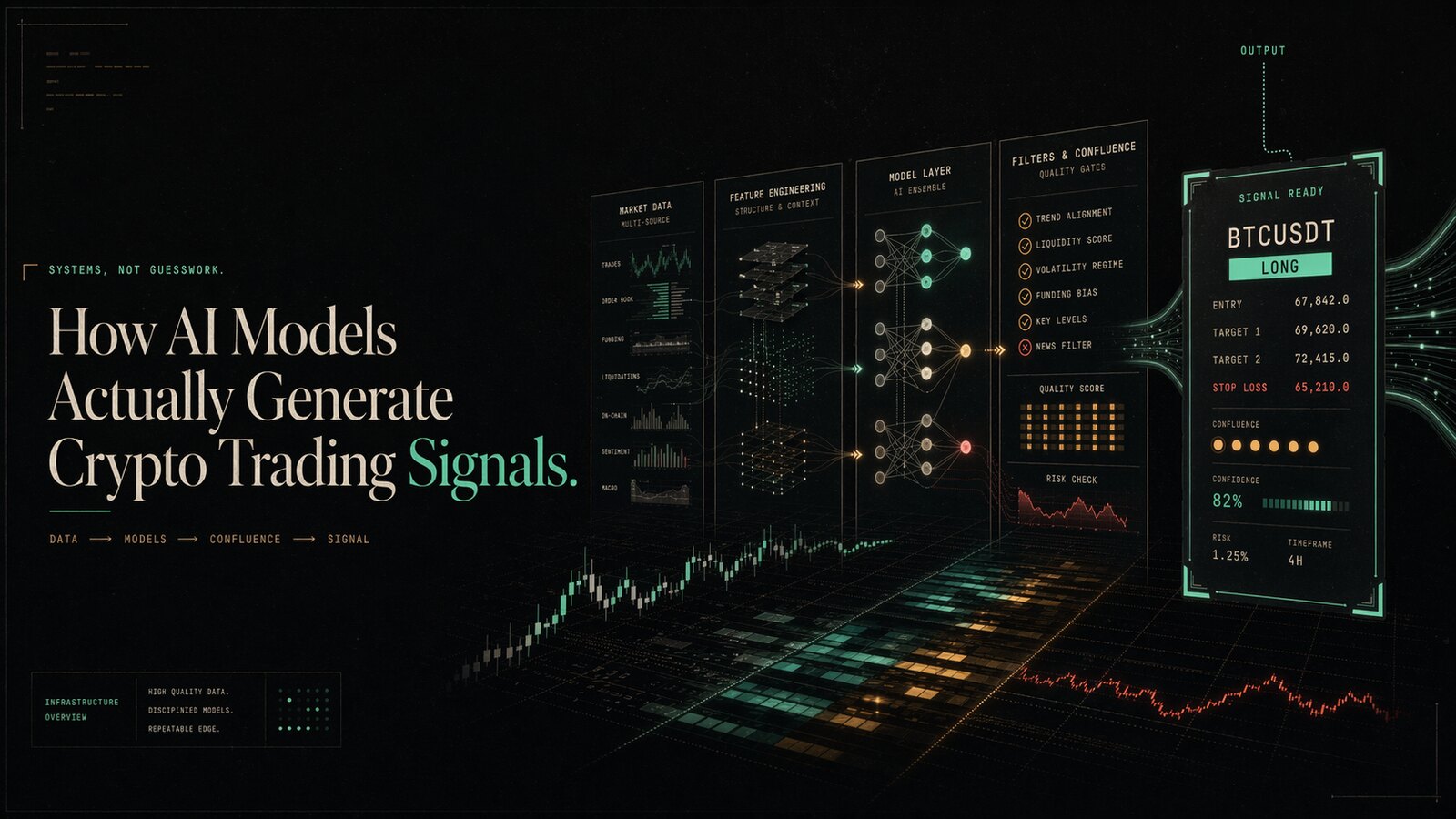
“AI-powered crypto signals” is one of the most overused phrases in 2026 trading marketing.
Every signal service claims it. Almost none explain what it means. And for good reason — most “AI” in retail crypto signals is either (a) a basic technical indicator with a neural network sticker slapped on the landing page, or (b) a marketing term for “we have a database and a cron job.”
This article is a deep technical walkthrough of how real AI signal systems actually work in 2026. We’ll cover the full pipeline — data ingestion, indicator confluence, machine learning filtering, human oversight, execution reconciliation — using concrete implementations from our own Pegasus Signals infrastructure at Ascendant Traders.
If you’re a subscriber trying to evaluate whether a provider’s “AI” is real, this article is your checklist. If you’re a developer curious about the architecture, this is the technical tour. If you’re just curious how the sausage is made, welcome.
⚠️ Disclaimer upfront: This article is educational content about trading system architecture. Nothing here is financial advice. Crypto trading carries substantial risk of loss regardless of how sophisticated the signal generation system is. No AI system eliminates market risk.
§1 — What “AI Signal Generation” Actually Means
Before we dive into architecture, let’s define the term.
An AI signal generation system is any automated pipeline that:
- Ingests market data continuously
- Applies analytical logic to detect trading opportunities
- Filters those opportunities against confluence criteria
- Outputs structured trade recommendations (entry, targets, stop-loss)
- Learns or adapts over time based on outcomes
The “AI” qualifier implies that at least one step — usually filtering or adaptation — uses machine learning techniques beyond simple rule-based logic.
The three levels of “AI” in commercial signal services
Level 1 — Rule-based systems with AI branding
The “signal” is generated when a fixed rule triggers: RSI below 30 and MACD bullish crossover, for example. No learning, no adaptation, no probabilistic filtering. Just thresholds.
Most “AI signal bots” on the retail market are Level 1 with marketing copy.
Level 2 — ML-assisted rule systems
Rules generate candidate signals. A machine learning model then evaluates the historical performance of similar setups and scores the confidence. Signals below a confidence threshold are filtered out.
This is the honest middle ground where most serious signal services (including ours) actually live.
Level 3 — End-to-end ML signal generation
A deep learning model ingests raw market data and outputs trading decisions without explicit rules. Think LSTM networks, transformer models, or reinforcement learning agents trained on massive historical datasets.
Level 3 exists at institutional trading firms (Renaissance, Two Sigma, Jane Street) and a handful of sophisticated retail providers. It requires tens of millions in R&D investment and continuous model retraining. If a $30/month retail service claims Level 3, be skeptical.
Most retail AI signal services operate honestly at Level 2. The distinction matters because Level 2 systems are explainable (you can inspect which indicators triggered the signal), while Level 3 systems are often black boxes (the model says “buy” but can’t articulate why).
§2 — The Data Layer: What the System Sees
Everything in a signal system starts with data. Quality in, quality out.
The core data streams
A competent signal system ingests at minimum:
- OHLCV candle data — Open, High, Low, Close, Volume for each time period (e.g., 1m, 5m, 15m, 1h, 4h candles)
- Live tick data or mark price — real-time price updates between candle boundaries
- Order book snapshots — bid/ask levels with associated volume, for detecting liquidity conditions
- Funding rates (for perpetual futures) — tells you whether the market is overly long or overly short
- Open interest — total leveraged positions, indicates macro conviction
- Volume-weighted metrics — VWAP, cumulative delta, etc.
Data sources
At Ascendant Traders, our primary data source is Blofin (our execution venue) supplemented by a CoinGecko fallback for 24-hour momentum cross-verification. Why this structure?
- Blofin gives us real exchange-level data at the venue where signals will actually execute — so there’s no slippage between “signal-assumed price” and “execution price” caused by using an aggregated data source
- CoinGecko provides an independent secondary confirmation — if our Blofin data is saying one thing but CoinGecko’s broader market aggregate disagrees strongly, that’s a flag to filter the signal
The lesson: single-source data is a vulnerability. Serious AI signal systems cross-verify signals against independent data streams before firing.
Timing and latency
Raw data ingestion latency matters. If your data is 15 seconds stale by the time your AI evaluates it, you’re trading on old information. The good news: modern exchanges expose WebSocket streams that deliver data with sub-100ms latency. The bad news: most cheap “signal bots” poll REST endpoints every 5-30 seconds because WebSocket infrastructure is harder to build.
Ask any provider how they ingest data. “REST polling” is a Level 1 system regardless of what else they claim.
§3 — The Indicator Layer: Feature Engineering
Once data is ingested, the system computes technical indicators — derived metrics that attempt to quantify market conditions.
Each indicator is a lens. A single lens is misleading. Multiple lenses — combined intelligently — form the basis of confluence filtering.
The core indicators in a modern signal pipeline
Momentum: RSI (Relative Strength Index)
RSI measures the speed of recent price changes, scaled 0-100. Above 70 is “overbought” (likely to pull back); below 30 is “oversold” (likely to bounce).
But RSI alone is a terrible signal. Markets can stay overbought for weeks during strong trends. Using RSI as a standalone trigger is the classic beginner mistake.
Trend direction: EMA 20 and EMA 50 (Exponential Moving Averages)
EMAs smooth price data. EMA 20 responds faster to recent changes; EMA 50 shows intermediate trend.
When EMA 20 crosses above EMA 50 with rising price: bullish bias. When EMA 20 crosses below EMA 50 with falling price: bearish bias. Simple but effective as a trend filter.
Trend strength: ADX (Average Directional Index)
ADX measures how strongly the market is trending, regardless of direction. ADX above 25 indicates a strong trend; below 20 indicates a ranging market.
Critical insight: the same signal has wildly different probability of working depending on ADX. A breakout pattern in ADX 35 (strong trend) is much more reliable than the same pattern in ADX 15 (choppy range). Ignoring this is why so many signal services with great “logic” have mediocre real-world performance.
Momentum confirmation: MACD
MACD (Moving Average Convergence Divergence) is a trend-following momentum indicator. Its histogram crossing zero from below indicates rising bullish momentum.
MACD + RSI in agreement is far more reliable than either alone.
Fair value reference: VWAP (Volume-Weighted Average Price)
VWAP is the average price weighted by volume, typically reset daily. Institutional traders use it as a benchmark — buying below VWAP is “good,” selling above VWAP is “good.”
Retail signal systems use VWAP alignment as a sanity check. A long setup where price is significantly below VWAP has different implications than one where price is above VWAP.
Volatility and stop-loss sizing: ATR (Average True Range)
ATR measures average price movement over a lookback period. It’s essential for setting stop-losses that don’t get triggered by normal noise.
A signal that places its stop-loss at 0.3% when ATR is showing 1.2% is going to get stopped out on noise constantly. A signal that places its stop at 1.5 × ATR is robust. This is why ATR-based stops are the standard at serious services.
Liquidity confirmation: Volume
Price moves on volume. A breakout on low volume is suspicious (likely to reverse). A breakout on expanding volume is more likely to continue.
Combining indicators: the confluence approach
At Ascendant Traders, a signal candidate must satisfy agreement across multiple indicators before progressing further:
- RSI in appropriate zone for direction
- MACD agreement (momentum supporting the direction)
- EMA 20/50 alignment
- EMA 50 slope confirming intermediate trend
- ADX above threshold for trend strength
- VWAP alignment with direction
- Volume confirmation
- Independent CoinGecko 24-hour momentum cross-check
If any single indicator dissents, the candidate is discarded. This is conservative by design — we’d rather miss a profitable trade than fire a low-confluence signal.
The number of simultaneously agreeing indicators is the difference between a Level 1 system (1-2 indicators) and a Level 2 system (6-8 indicators with dissent filtering).
§4 — The Filtering Layer: Where ML Enters
So far, everything we’ve described is rule-based. Now we add ML.
Suppose your rule-based system generates 30 candidate signals a day on BTC/ETH/SOL. That’s too many — most won’t be high quality. You need a second filter to keep only the best.
Historical pattern matching
An ML filter takes each candidate signal and asks: in historical data, how did setups that looked like this one actually perform?
Features fed to the model include:
- Current values of all indicators at signal time
- Time of day and day of week
- Recent market volatility regime
- Correlation between BTC/ETH/SOL in the current window
- Recent funding rates
- Open interest trends
The model has been trained on thousands of historical setups with known outcomes. It scores the current candidate against its learned distribution and outputs a confidence score.
If the confidence score is above a threshold, the signal is published. If not, it’s discarded silently.
The problem with overfitting
A naive ML model can “learn” the training data perfectly and fail completely on new data. This is overfitting — memorizing historical patterns that don’t generalize.
Techniques to prevent overfitting:
- Out-of-sample testing: train on data from 2022-2024, test on 2025 data
- Walk-forward validation: continuously retrain and re-evaluate as new data arrives
- Regularization: mathematical penalties that keep the model from getting too complex
- Cross-validation: multiple train/test splits to confirm robustness
Serious signal services track their model’s out-of-sample performance and retrain regularly. Sketchy ones train once and never revisit — which is why their real-world winrate degrades steadily as market regimes shift.
Why most retail “ML” is actually Level 1
The inconvenient truth: building, testing, and maintaining a real ML filter takes significant engineering effort. Many “AI-powered” retail services shortcut by hard-coding confidence scores based on indicator values — without any real ML training. The “AI” label is marketing.
Signs a provider has real ML in the loop:
- They discuss retraining cadence in their documentation
- Their winrate shows modest month-over-month drift (not perfectly stable)
- They can explain which features matter most (e.g., “ADX has the highest contribution to confidence scoring”)
- They publish validation methodology at some level
Signs it’s Level 1 rebranded:
- Confidence is a simple multiplier of indicator strength
- No mention of training data or validation
- “Our AI” is used interchangeably with “our algorithm” throughout marketing
§5 — The Human Layer: Why Pure Automation Is Suboptimal
If AI is so good, why do the best signal services still have human analysts in the loop?
Because AI models see patterns, not context.
Things AI models miss:
- Macro events: Fed meetings, CPI releases, major regulatory announcements. An AI trained on 2022-2024 data doesn’t “know” that a rate decision is happening in 20 minutes. A human does.
- Exchange-specific anomalies: Binance pausing withdrawals, Bybit having an API outage, Blofin announcing a token listing. An AI just sees price data.
- Narrative shifts: When “AI tokens” are hot this month and “DePIN tokens” are hot next month, correlations shift. Purely backward-looking ML may still be using last month’s correlation assumptions.
- Black swan events: terror attacks, geopolitical crises, exchange hacks. AI models trained on “normal” data misbehave in tail events.
The hybrid workflow
At Ascendant Traders, our actual signal workflow is:
- Automated scanner continuously evaluates candidates across BTC, ETH, SOL
- Confluence filter (rule-based + ML) filters candidates to high-confidence only
- Admin approval queue presents qualifying candidates to a human analyst
- Human review applies contextual filters (macro awareness, recent signal saturation, market regime suitability)
- Published signal goes to Discord + Telegram with entry, targets, SL, expiry
The human step takes 30-90 seconds per candidate. It’s not about second-guessing the AI’s math. It’s about catching the 5% of situations where the math is right but the context is wrong.
Pure automation would publish all qualifying candidates. Hybrid review publishes ~70-80% of them, skipping the ones where context flags risk.
§6 — The Execution Layer: Where Signals Become Trades
A signal without execution is just an idea. The infrastructure between “signal generated” and “trade executed” has its own engineering challenges.
Publishing latency
When the scanner detects a valid signal, how fast does it reach subscribers?
Naive implementation: scanner → database write → Discord bot polling the database every 30 seconds → post to channel.
Total latency: up to 30 seconds from detection to publication.
Better implementation: scanner → message queue → Discord webhook fired immediately → cross-posted to Telegram via bot API in parallel.
Total latency: 2-5 seconds.
Best implementation: above + real-time subscriber notification via custom WebSocket + machine-readable JSON block for auto-traders.
Latency matters because price is moving. A signal delivered 30 seconds late means subscribers enter 30 seconds of price drift past the intended entry.
Signal expiry
Every signal should have an expiry. Without one, a signal from 6 hours ago remains “active” in the channel even though the market has moved far past the entry.
At Ascendant Traders, signals expire 4 hours after posting if unfilled. This prevents subscribers from executing stale setups based on outdated market conditions.
Tracking and reconciliation
Once published, the system tracks:
- Current price vs entry, target levels, and SL
- Fill timestamps (when price first reached entry)
- Exit timestamps (when price reached any TP or SL)
For members with Blofin API credentials configured, we can also reconcile against actual fills — the exact price the member got filled at, accounting for slippage and order book depth. This is the difference between “theoretical performance” (what the signal prescribed) and “realized performance” (what the subscriber actually experienced).
The database layer
Signal history needs to persist. Our infrastructure uses SQLite with a simple schema:
signalstable: id, pair, direction, entry, tp1/2/3, sl, posted_at, expiry, statustradestable: id, signal_id, fill_price, fill_time, exit_price, exit_time, outcome, realized_pnlindicator_snapshotstable: indicator values at time of signal (for retrospective analysis)
Simple schema. Boring. Reliable. This is usually the right choice for retail-scale infrastructure.
§7 — The Feedback Loop: How the System Improves
A Level 2 system improves by learning from its own outcomes.
Tracking what works and what doesn’t
For every signal, we record:
- Full indicator state at signal time
- Outcome category: TP1 hit, TP2 hit, TP3 hit, SL hit, expired
- Time to outcome
- Peak adverse excursion (how far against the position did it go before resolving?)
- Peak favorable excursion (how far in favor before resolving?)
Over hundreds of trades, patterns emerge:
- “Signals fired when ADX > 30 have 72% winrate”
- “Signals fired during Asian session on SOL have 45% winrate”
- “Short signals when RSI is in 60-70 range underperform”
This data drives the next generation of filtering thresholds.
Retraining cadence
Our ML filter is retrained monthly on the trailing 90 days of actual outcome data. This keeps the model current with prevailing market regimes.
Retraining quarterly or less is where providers’ real winrates start drifting away from advertised numbers. The market regime changes faster than their model does.
The cold-start problem
What happens when you launch a new signal system with no historical outcome data?
You either:
- Pretrain on backtested data (faster but fragile — backtests lie)
- Launch with rule-based filtering only, collect real outcomes, add ML after 500+ signals (slower but honest)
We took the second approach. For the first 3-4 months of Pegasus Signals operation, the system was effectively rule-based with heavy human filtering. As we accumulated outcome data, the ML filter got trained incrementally.
This is why new signal services with outsized claims should be suspect — they haven’t had time to validate their models against real outcomes.
§8 — Common Architecture Mistakes (Anti-Patterns)
If you’re considering any signal service, here are the architectural red flags to watch for.
Anti-pattern 1: “We use AI” with no technical detail
If the provider can’t tell you what their AI does — what features it uses, what it outputs, how it’s validated — the AI is almost certainly marketing.
Anti-pattern 2: Trading on backtested performance with no live track record
Any strategy can look profitable on backtests. The real test is live performance over 3-6+ months. Services that advertise “70% winrate (backtested)” are advertising a fiction.
Anti-pattern 3: Using mid-price for entry and exit calculations
Real trades happen at bid/ask, not mid-price. A service that calculates winrate using mid-price is systematically overstating performance by half the spread on every trade. Over 500 trades at 0.05% spread, that’s 12.5% of inflated “performance.”
Anti-pattern 4: No handling of correlated simultaneous signals
If the system fires long signals on BTC, ETH, and SOL within the same 30-minute window, that’s effectively one macro bet with 3x notional. Serious systems either limit concurrent correlated signals or warn subscribers about aggregate exposure.
Anti-pattern 5: Public performance stats don’t match private channel reality
Marketing page says 85% winrate. Actual channel history shows 50% of signals hitting SL. One of these is lying.
Anti-pattern 6: No signal expiry
Signals from 8 hours ago sitting as “active” in the channel is lazy infrastructure. Subscribers executing on stale signals is a real cause of poor results.
Anti-pattern 7: Opaque model changes without notification
A legitimate service will announce “we retrained the filter this month; expect behavior changes.” A sketchy one just silently tweaks thresholds when performance stats look bad, then announces the “new version” has higher winrate.
§9 — What Makes a Signal System Actually Good
Based on everything above, here are the markers of a well-architected signal generation system:
- Multiple data sources with cross-verification (primary exchange + secondary aggregator)
- Sub-100ms ingestion latency (WebSocket, not REST polling)
- Confluence across 5+ indicators (not single-indicator triggers)
- ML filter with documented retraining cadence (monthly or more frequent)
- Human-in-the-loop review for contextual sanity checks
- Sub-5-second publishing latency (scanner to subscribers)
- Explicit signal expiry (4 hours is a reasonable default)
- Separate tracking for theoretical vs realized outcomes (reconciled against actual fills when possible)
- Transparent winrate methodology (net PnL positive under suggested scaling, not “TP1 brush”)
- Public change log for system updates (so subscribers can correlate performance shifts with system changes)
A system hitting 8-10 of these markers is serious. A system hitting 4-6 is competent. A system hitting 0-3 is either marketing fluff or a scam.
§10 — A Realistic Look at Our Own System
Full disclosure from Ascendant Traders:
Our Pegasus Signals pipeline hits roughly 9 of the 10 markers above. The one we’re still building out is the public change log — right now, system updates are communicated in our Discord but not published as a standalone version history. It’s on the roadmap.
Honest capabilities:
- Level 2 system: rule-based confluence + ML filter + human review
- 8 indicators in confluence calculation
- Dual-source data (Blofin primary + CoinGecko fallback)
- Sub-3-second publishing latency Discord + Telegram
- 4-hour signal expiry
- Monthly ML retraining on trailing 90 days
- Optional API reconciliation against Blofin fills for members
- Every signal is tracked publicly from entry to close — wins and losses both
Honest limitations:
- We are not Level 3. We don’t claim to be.
- We don’t lead with a winrate number — markets shift, and any single figure is past performance, never a promise of what comes next
- We trade only BTC, ETH, SOL — not because altcoins are bad but because liquidity, volume, and data quality are dramatically better on the big three, and the system was designed around that
- Our scanner can produce false positives during extreme volatility regimes (flash crashes, stablecoin depegs); human review catches most, but not all
If another provider describes their system in similar honest terms, they’re probably comparable. If another provider claims institutional-grade AI with 95%+ winrate at a $30/month price point, you now have the technical knowledge to call the bluff.
Frequently Asked Questions
Can I build my own AI signal system?
Yes, with effort. The tooling exists — Python + ccxt for exchange APIs, scikit-learn or PyTorch for ML, TimescaleDB for time-series data. A solo developer can get a basic Level 2 system running in a few months. Production-grade systems take 6-18 months to build and validate.
Do deep learning models outperform rule-based systems?
In backtests, often yes. In live trading, often no — because deep learning models overfit to historical patterns that don’t persist in future market regimes. The best retail systems tend to be hybrid: rule-based core + shallow ML filter + human oversight.
How much data is needed to train a decent signal filter?
For a Level 2 filter on 4H-timeframe BTC/ETH/SOL signals, you want at least 1,000 real outcomes to train on. 5,000+ is better. With 100-200 outcomes, the model is statistical noise.
Why do signal services not publish their full methodology?
Some because it’s proprietary IP. Some because they don’t actually have one (the black box hides the fact that there’s nothing there). Legitimate services publish enough to demonstrate competence without giving away competitive edge.
Is a fully-automated signal system safer than a hybrid one?
Not in our experience. Automation is faster and cheaper but misses context. Hybrid systems publish slightly fewer signals but with materially higher quality. For most retail users, signal quality matters more than frequency.
How do I know if the “AI” in a service is real?
Ask technical questions. Real engineers can answer them. Marketers can’t. Sample questions: “What indicators feed your ML filter?”, “How often do you retrain?”, “What’s your validation methodology?”, “What’s the latency from signal generation to publication?”. Vague answers → Level 1 with AI branding.
Final Takeaway
Real AI signal generation in 2026 is a serious engineering discipline. Data ingestion, indicator computation, ML filtering, human oversight, execution reconciliation — each layer has its own challenges and trade-offs.
Most of what’s marketed as “AI-powered” is at best Level 2 with clean execution, and at worst Level 1 with good copywriting. The signals themselves are generated by the same kind of rule-based logic that TradingView users have been building for a decade.
That’s not bad — a well-engineered Level 2 system produces genuinely useful signals. But it’s different from the implied “superhuman AI makes you rich” marketing frame.
When evaluating any signal service, skip the marketing page. Read the docs. Ask the technical questions. If the provider can’t articulate their own architecture, they don’t really have one.
The best signals come from honest engineering, not clever branding.
⚠️ Reminder: This article is educational content about trading system architecture. It does not constitute financial advice. No signal system — regardless of architectural sophistication — eliminates market risk. Crypto trading carries substantial risk of loss including total loss of capital. Always trade within your risk tolerance.
Curious how a Level 2 hybrid system actually feels from the subscriber side?
Join the free Ascendant Traders Discord → discord.gg/fcPV99aD9z
Observe our AI-generated signals on BTC, ETH, and SOL. Read the setup notes. See how confluence, filtering, and human review produce (or don’t produce) results in real time. It’s all free.