
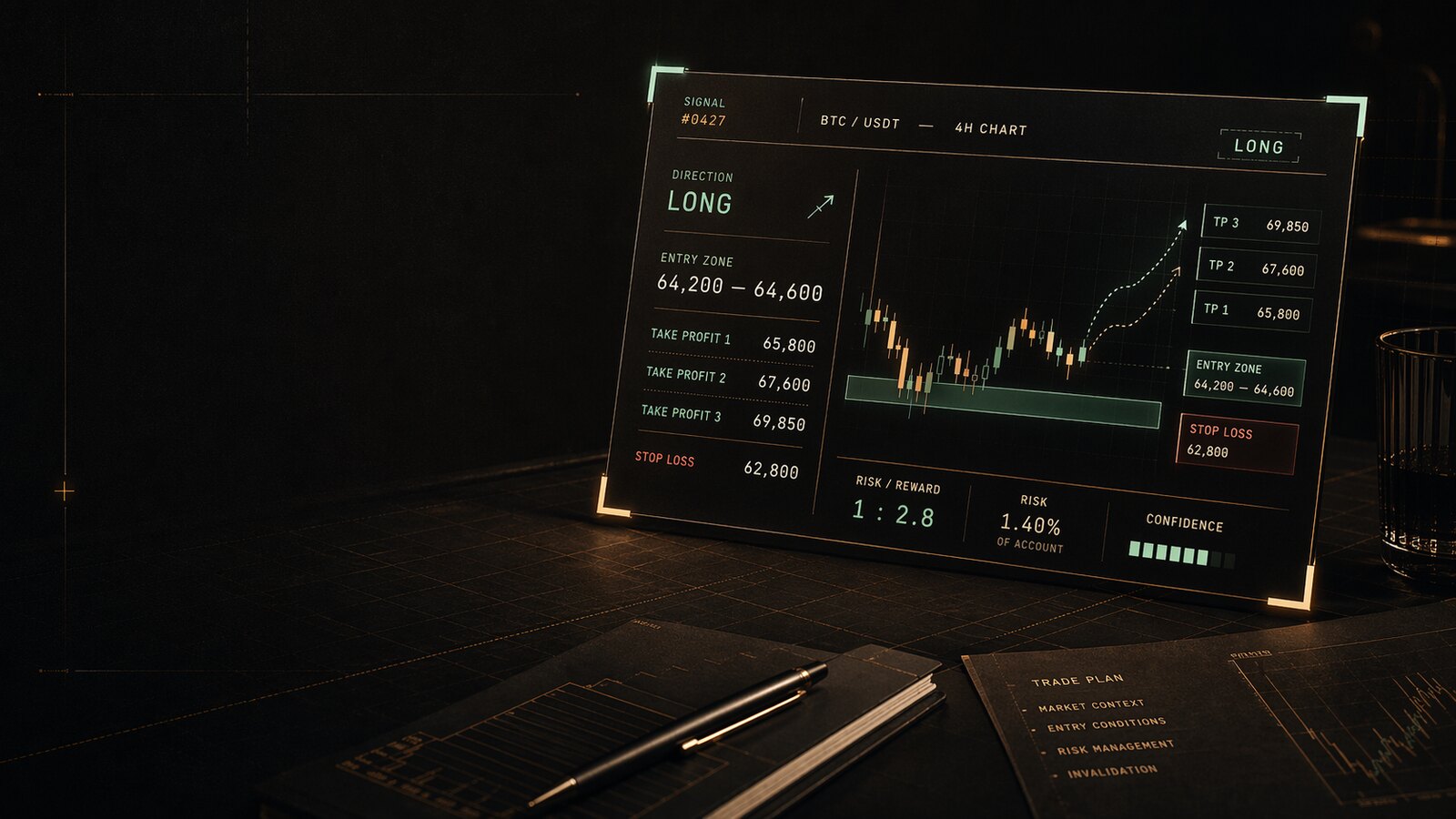
You joined a Discord. You joined a Telegram. And now you’re staring at a message that looks something like this:
🟢 BTC/USDT LONG
Entry: 67,420 – 67,520
TP1: 68,100 (+1%)
TP2: 68,800 (+2%)
TP3: 69,900 (+3.7%)
SL: 66,850 (-0.85%)
Leverage: 3-5x
R/R: 1:4.3
If you understand every line at a glance, this guide isn’t for you.
If you’re reading “TP1,” “SL,” and “R/R” and quietly wondering what the hell is going on — stay. By the end of this article, you’ll read a signal the way a pro reads one: quickly, confidently, and with an exact sense of what it’s asking you to risk and what it promises in return.
We’ll cover the anatomy of a signal, the seven components that matter, a live walkthrough of a real trade, the seven mistakes that destroy beginners, and the one rule that separates people who make money from signals from people who just hemorrhage capital.
Let’s go.
⚠️ Before anything else: This is educational content. Nothing in this article is financial advice. Crypto trading — especially leveraged futures trading — carries substantial risk of loss. Trade only with capital you can afford to lose completely, and never treat a trading signal as a guarantee of anything.
§1 — What Is a Crypto Trading Signal, Exactly?
A crypto trading signal is a specific, actionable trade instruction. It tells you four things at minimum:
- What to trade — a specific crypto pair (BTC/USDT, ETH/USDT, etc.)
- Which direction — long (bet the price goes up) or short (bet the price goes down)
- Where to enter — the price at which you should open the position
- Where to exit — both the targets (where you take profit) and the stop-loss (where you cut losses)
Anything missing one of those four is not a signal. It’s a hot take. “BTC looks bullish, probably going to 80K” is not a signal. It’s someone’s opinion wearing a suit.
A good signal — the kind we’re going to teach you to read — also includes:
- The recommended leverage (or guidance that leverage is optional)
- The risk/reward ratio
- An expiry time or invalidation condition
- Sometimes a short note on the setup: what the analyst or AI saw that triggered the call
In 2026, most high-quality signals come from AI systems that scan markets 24/7, layered with human oversight to filter out low-confidence setups. Pure human-generated signals still exist (and some are excellent), but the majority of serious crypto signal services — ours included — lean heavily on automation for the scanning and generation step.
§2 — The Anatomy of a Signal, Component by Component
Let’s take that signal from the intro and dissect it line by line.
The pair: BTC/USDT
BTC/USDT means you’re trading Bitcoin against Tether (USDT), a dollar-pegged stablecoin. The first symbol is the asset you’re buying or selling; the second is what you’re buying or selling it with.
When you see ETH/USDT or SOL/USDT, same structure: Ethereum or Solana priced in USDT.
Why USDT and not USD? Because most crypto trading happens on exchanges where the “dollar” side of the pair is actually a stablecoin that mimics USD 1:1. The practical difference for you is zero.
The direction: LONG (or SHORT)
- LONG = you’re betting the price will go up. You open the position, and you profit if the price rises above your entry.
- SHORT = you’re betting the price will go down. You open the position, and you profit if the price falls below your entry.
Shorting is more complicated under the hood (you’re technically borrowing the asset to sell it, then buying it back later cheaper), but on a modern derivatives exchange like Blofin or Bybit, the button is literally labeled “Short.” You click it, you hold, you close. The mechanics are invisible to the user.
A small but important note: shorting is riskier than longing for beginners. If you long and the asset goes to zero, you lose 100% of your position. If you short and the asset goes to infinity, you theoretically lose infinity. In practice, exchanges liquidate you long before that happens, but the asymmetry is real. If you’re brand new, consider sticking to longs for your first dozen trades.
The entry: Entry: 67,420 – 67,520
This is the price (or price range) at which you should open the position.
A single number like Entry: 67,420 means the signal was built around that exact price. You should try to open the position as close to that number as possible.
A range like Entry: 67,420 – 67,520 gives you flexibility. The analyst thinks anywhere inside that range is a valid entry. You can place a limit order in the middle or leg in with multiple smaller orders.
What if the price has already moved past the entry range when you see the signal? Depending on how much it’s moved, you have two choices:
- If it moved past by less than 0.5% — you can still take the trade, but your risk/reward is now worse. Recalculate before entering.
- If it moved past by more than 1% — skip the trade. The setup has changed. Never chase.
Chasing trades is one of the most expensive habits in crypto. Learn to skip.
The take-profit targets: TP1, TP2, TP3
Take-profit (TP) levels are where you should close some or all of the position to lock in profit.
Why three levels instead of one? Because markets don’t move in straight lines, and scaling out helps you capture profit even if the full move doesn’t complete.
A common scaling approach:
- At TP1, close 30-50% of your position. Now your remaining position is “playing with house money” — you’ve locked in the entry cost.
- At TP2, close another 30-40%.
- At TP3, close the rest or let a trailing stop take you out.
Each TP level shows the price (e.g. 68,100) and often the percentage gain from entry (e.g. +1%). Some signal providers only show percentages; some only show prices. Both work.
A signal with just one TP is not automatically worse than one with three — some setups are designed for a single-target close. But for volatile pairs like BTC/ETH/SOL, three levels generally produce better risk-adjusted returns.
The stop-loss: SL: 66,850 (-0.85%)
The stop-loss is the price where the trade is considered invalidated, and you close the position to prevent further losses.
This is the most important number on the whole signal. It defines your maximum acceptable loss. Everything else flows from this.
The stop-loss has two purposes:
- Mechanical: if you set a stop-loss order on the exchange, your position closes automatically when the price hits that level. You don’t have to watch the chart.
- Psychological: it forces you to pre-commit to the exit. You decide before emotions kick in. When the price is actually approaching your SL, your brain will scream at you to “give it a little more room.” That’s when traders die. A pre-set SL on the exchange eliminates that debate.
Never trade a signal without setting the stop-loss order. This is the single piece of advice that will save more money than anything else in this guide.
The leverage: Leverage: 3-5x
Leverage multiplies both your potential profit and your potential loss.
- 1x leverage = you’re trading with your own money only. If the asset moves 2%, you gain or lose 2% of your capital.
- 3x leverage = you’re effectively borrowing 2x your capital from the exchange. If the asset moves 2%, you gain or lose 6% of your capital.
- 10x leverage = you gain or lose 20% of your capital on a 2% move. Liquidation (total loss of the position) triggers around 8-10% of adverse move.
Good signal providers specify a leverage range (e.g. 3-5x) because different traders have different risk tolerances, and different market conditions justify different exposure.
Ignore the advertised range if it exceeds your risk tolerance. If a signal says Leverage: 10-20x and you’re not comfortable losing 50%+ of the position on a single trade, use 3x and size accordingly. The signal still works at lower leverage — you just make less on winners and lose less on losers.
Beginner rule of thumb: Start with 2-3x leverage for your first 20 trades. Period. Anyone telling you 20-50x leverage is the path to generational wealth is either lying or about to be liquidated.
The risk/reward ratio: R/R: 1:4.3
The risk/reward ratio tells you how much you stand to gain versus lose on the trade, assuming TP3 hits and the stop-loss triggers on failure.
1:4.3 means: for every $1 you’re risking (the distance from entry to stop-loss), you stand to gain $4.30 (the distance from entry to TP3).
A few rules:
- R/R below 1:1.5 → the trade is barely worth taking. Only do it if you believe the probability of hitting TP is very high.
- R/R between 1:2 and 1:3 → standard, decent setups.
- R/R above 1:3 → strong setup. You can be wrong more often than right and still make money.
A winrate of 50% at 1:3 R/R is a profitable strategy. A winrate of 80% at 1:0.5 R/R is not. Math beats hope.
§3 — A Walkthrough: What This Signal Actually Asks You to Do
Back to our example:
🟢 BTC/USDT LONG
Entry: 67,420 – 67,520
TP1: 68,100 (+1%)
TP2: 68,800 (+2%)
TP3: 69,900 (+3.7%)
SL: 66,850 (-0.85%)
Leverage: 3-5x
R/R: 1:4.3
Translated into plain English, this signal is saying:
“Open a long position on Bitcoin/USDT somewhere between $67,420 and $67,520. If it works, take profit in three tranches: first at $68,100, then at $68,800, and finally at $69,900. If it fails and Bitcoin drops to $66,850, close the position and accept the loss — that’s the trade-invalidation level. You can use 3 to 5 times leverage depending on your risk appetite. For every $1 you risk, you stand to make $4.30 if the full plan plays out.”
Now let’s size it in dollars.
Say you have $1,000 in your trading account, and you decide to risk 1% of your capital on this trade. That’s $10 of maximum acceptable loss.
Step 1 — Calculate your position size.
- Entry: ~$67,470 (midpoint)
- Stop-loss: $66,850
- Distance: $67,470 - $66,850 = $620
- Loss per $1 of position = $620 / $67,470 ≈ 0.918%
To lose exactly $10 on this trade, your position size needs to be: $10 / 0.918% = $1,089 of notional exposure.
At 3x leverage, your actual capital used (margin) is: $1,089 / 3 = $363.
Step 2 — Calculate your potential profit.
If TP3 hits:
- Price moves from ~$67,470 to $69,900 = +$2,430 = +3.6%
- Your $1,089 position gains 3.6% = $39.20 in profit
So you risked $10 to make potentially $39.20. That’s the 1:4.3 ratio in dollar terms.
Step 3 — Place the orders.
On your exchange (Blofin, Bybit, whatever you use):
- Open a long position of ~$1,089 notional at entry price with 3x leverage
- Set a limit sell order at $68,100 for 40% of the position (TP1)
- Set a limit sell order at $68,800 for 30% of the position (TP2)
- Set a limit sell order at $69,900 for 30% of the position (TP3)
- Set the stop-loss order at $66,850 (this one is non-negotiable)
Now you walk away. Don’t stare at the chart. The orders will execute themselves.
That’s it. That’s what reading a crypto signal looks like when you actually understand it.
§4 — The Seven Mistakes That Kill New Traders
Every single one of these is a mistake we’ve watched traders make, over and over, in every signal community. Print this section. Tape it to your monitor.
Mistake 1: Skipping the stop-loss
“I’ll just watch it and close it manually if it gets bad.”
No, you won’t. You’ll freeze, hope, and watch your position bleed 15% while telling yourself it’s about to bounce. Every trader believes they’re different. They’re not. Set the SL on the exchange. Always.
Mistake 2: Using too much leverage
Leverage is a dial, not a dogma. 20x on a volatile altcoin is not “aggressive trading.” It’s gambling with the leverage set to “liquidate me in 45 minutes.” Use 2-3x until you’ve proven to yourself, over 50+ trades, that you can stay disciplined on stops.
Mistake 3: Chasing after the entry
If the price has already moved past the entry by more than 1%, the risk/reward is broken. Skip the trade. There will be another signal in a few hours. There always is.
Mistake 4: Moving the stop-loss further away
The instant you move your stop-loss to “give the trade more room,” you’ve stopped following the signal and started following your feelings. This is the single most expensive habit in all of retail trading. If the setup invalidates, take the loss. It’s the cost of doing business.
Mistake 5: Oversizing after a loss
The “revenge trade” is a universal trap. You lost $10 on the last signal, so you size up 5x on the next one to make it back. Now when it fails — and it will, eventually — you’ve lost $50. Then you go 10x. Then you blow the account. Stay disciplined with fixed 1-2% position sizing regardless of recent outcomes.
Mistake 6: Following every single signal
A signal group might post 4-6 signals a day. You do not have to take all of them. Pros take the ones that fit their risk appetite, their available time, and the market regime. Beginners should skip any signal with a risk/reward below 1:2, any short signal until they’ve mastered longs, and any signal during major macro events (Fed meetings, CPI releases) where volatility is insane.
Mistake 7: Treating signals as guarantees
A 65% winrate means 35% of trades lose. A 75% winrate means 25% lose. No signal provider on Earth has a 95% winrate across hundreds of trades. If you treat every signal as a guaranteed winner and size accordingly, the first loss will destroy you emotionally and the third will destroy you financially.
Signals are probability-weighted trade ideas. Treat them that way.
§5 — Reading the Signal in Context: The Setup Notes
The best signal providers add a short description of why the trade is being called. Something like:
“RSI bounced off oversold (28) on the 4H chart. EMA 20 just crossed above EMA 50 with strong volume confirmation. ADX reading 34 indicates a strong trend. VWAP alignment bullish. Blofin order book shows thin resistance until $68,100.”
Don’t skim past this. Even if you don’t understand every indicator yet, over time you’ll start to recognize the patterns that tend to win versus the ones that tend to fail. Journaling setups alongside your P&L is one of the fastest ways to go from “signal follower” to “signal evaluator” — and eventually, if you want, “signal creator.”
Key indicators to learn (in order of importance):
- RSI — momentum; tells you when an asset is overbought or oversold
- EMA 20 / EMA 50 — trend direction
- MACD — trend momentum + potential reversals
- ADX — trend strength (not direction)
- VWAP — fair value reference
- ATR — volatility; drives stop-loss sizing
- Volume — confirmation of everything above
You don’t need to master these to follow signals. But understanding the logic behind a signal is the difference between trading with the signal provider and trading under them. You want to be with them.
§6 — Where Signals Go Wrong (So You Can Spot It Early)
Not every signal is well-constructed. Even signals from good providers can be subpar from time to time. Here’s how to spot trouble before you enter:
- Entry and stop-loss are very close together. If the SL is 0.2% away from entry and the TP is 3% away, the setup looks attractive (huge R/R) but in reality, crypto markets will wick 0.2% just from breathing. You’ll get stopped out on noise.
- No leverage guidance given. Signals that assume you’ll figure out your own leverage are either lazy or assume you’re an expert. Neither is ideal for beginners.
- No entry range and the price is already moving. If you can’t get filled at the entry price, the R/R math falls apart.
- Targets wildly disproportionate to volatility. A TP3 at +15% on BTC in a sideways market is fantasy. Check what “normal” moves are for the asset and time frame.
- SL placement that makes no technical sense. A good SL is placed below a meaningful support level (for longs) or above resistance (for shorts). A SL that’s “just below entry” with no structure justification is fragile.
Learning to spot these takes reps. Follow signals on paper for two weeks before committing real capital. Every signal community worth anything encourages paper trading for new members.
§7 — How AI Changes Signal Reading
In 2026, most competitive signal providers run AI-driven scanners that evaluate hundreds of setups in parallel and surface only the ones meeting multiple confluence criteria. At Ascendant Traders, for example, our signal engine requires agreement across RSI, MACD, EMA crossovers, ADX strength, VWAP alignment, volume confirmation, and a secondary CoinGecko 24-hour momentum check before posting a signal. A setup that misses any of those is discarded.
This matters for you as a signal reader because:
- The signal you’re looking at has already been filtered. It passed checks that a human analyst might have missed. That doesn’t mean it will win, but it does mean the baseline quality is higher than “some guy’s gut feeling.”
- The reasoning can be inspected. Good AI signal systems publish the indicator state at the time of the signal — which indicators were green, which were borderline, which confidence score triggered the post. You can read that and calibrate your own confidence.
- Signals have explicit invalidation windows. Our signals expire 4 hours after posting if the entry isn’t filled. This prevents you from taking stale trades. If a signal is 6 hours old and you’re just seeing it now, skip it — the market conditions that triggered it are likely gone.
- Separate tracking for paper-perfect vs real fills. AI systems reconcile against actual exchange order books (not just theoretical mid-price), so published winrates more closely reflect what you’d actually experience.
The AI does not replace judgment. It front-loads the heavy lifting so your judgment can focus on your variables: your size, your leverage, your timing, your risk tolerance.
§8 — A Practical Reading Checklist
Tape this next to the stop-loss rule from §4. Run through it for every signal, for the first 30 trades, until it becomes automatic.
Before you enter:
- Is this a pair I actually understand? (BTC/ETH/SOL are beginner-friendly; exotic pairs aren’t)
- Is it a long or a short? (Stick to longs until confident)
- Is the price still within the entry range? (If more than 1% past, skip)
- What is my maximum acceptable loss on this trade? ($ amount, not %)
- What position size does that imply at the given stop-loss distance?
- What leverage am I comfortable with given the volatility? (Hint: less than you think)
- Is the risk/reward at least 1:2? (If not, stronger argument needed to enter)
- Do I understand the setup notes, or at least trust the provider? (If neither, skip)
When you enter:
- Open the position at the correct size and leverage
- Place limit orders for each TP
- Set the stop-loss order on the exchange — not mentally, on the exchange
- Walk away from the chart
After the trade closes:
- Record the outcome in your trading journal
- Note the setup type, your emotional state, and whether you followed the plan
- Do NOT modify your strategy after a single trade — wait for 10-20 data points
§9 — The Unfashionable Truth About Signals
You can follow the best signals in the world and still lose money if your execution is bad. Conversely, mediocre signals executed with perfect discipline can make you money over time.
The signal is 30% of the trade. The other 70% is:
- Position sizing (did you risk the right amount?)
- Execution quality (did you enter at the right price?)
- Stop-loss adherence (did you actually keep the stop where it was set?)
- Emotional regulation (did you revenge-trade after a loss?)
- Record-keeping (are you learning from each trade?)
Signals get marketed as the core product because they’re the tangible thing you can sell. But the actual edge — the thing that separates profitable traders from unprofitable ones — is process discipline. Almost no one talks about this publicly because it doesn’t sell subscriptions. But it’s the truth.
Frequently Asked Questions
How do I know if a crypto signal is reliable?
Check three things: (1) Does every signal include entry, targets, and stop-loss? (2) Does the provider publish losing trades alongside winners? (3) Can you see their performance history without paying? If all three are yes, the provider is at least honest. Reliability comes from consistency over 100+ trades, not from any single number.
What’s the minimum capital to follow crypto signals?
Technically you can start with $100 on most derivatives exchanges. Practically, $500-1000 gives you more room to size positions correctly at 1-2% per trade. Below $200, the exchange fees eat into your PnL noticeably.
Should I auto-trade signals using a bot?
Auto-trading is powerful but dangerous if done wrong. Use API keys with trading-only permissions (never withdrawals). Start with tiny size to verify the bot behaves as expected. Most signal providers that offer auto-trading still require you to approve each trade manually in the first weeks — that’s a good sign.
Why do signal providers charge subscriptions if their signals are profitable?
Because running a signal service costs money (infrastructure, analyst time, AI compute, community moderation) and because the math of subscriptions is more predictable than the math of trading. A provider with 1,000 subscribers at $29/month makes $29,000/month. That’s more stable than any trading P&L, which is why you see this model everywhere.
How often should I expect signals?
Depends on the provider and the tier. Free tiers typically see 1-2 per day. VIP tiers at serious providers run 4-6 per day on active pairs. If someone promises 20+ signals per day, they’re either scalping (which requires serious speed and slippage control) or pumping out low-confidence setups to justify the subscription.
Can beginners actually make money following signals?
Yes — but only if they follow the discipline rules in §4. The signals themselves are solvable. The behavioral problems are what kills most retail traders. A disciplined beginner following a 65%-winrate signal service with 1:2.5 R/R should be modestly profitable over 100 trades. An undisciplined beginner following a 95%-winrate service (if such a thing existed) would still likely blow up.
Final Takeaway
A crypto trading signal is a complete trade plan compressed into seven lines. Once you can read it fluently, you’ve unlocked access to a huge amount of collective analysis without having to do the analysis yourself.
But reading a signal is only the entry fee. The actual work is doing the other 70% — position sizing, execution, stop-loss discipline, emotional regulation, journaling — correctly, consistently, for months.
Do that, and signals start paying for themselves. Skip it, and no signal provider in the world can save you.
Good luck out there. Trade small. Set your stops. And remember: the next signal is always coming.
⚠️ Reminder: This article is educational and informational only. It is not financial advice. Crypto trading involves substantial risk of loss, including total loss of capital. Past performance of any signal service does not guarantee future results. Trade only with capital you can afford to lose completely.
Want to see this in action?
Join the free Ascendant Traders Discord → discord.gg/fcPV99aD9z
Our channels post signals daily on BTC, ETH, and SOL so you can practice reading them before committing capital. The full feed — with real-time delivery and auto-tracking, in all 8 languages — is free.