
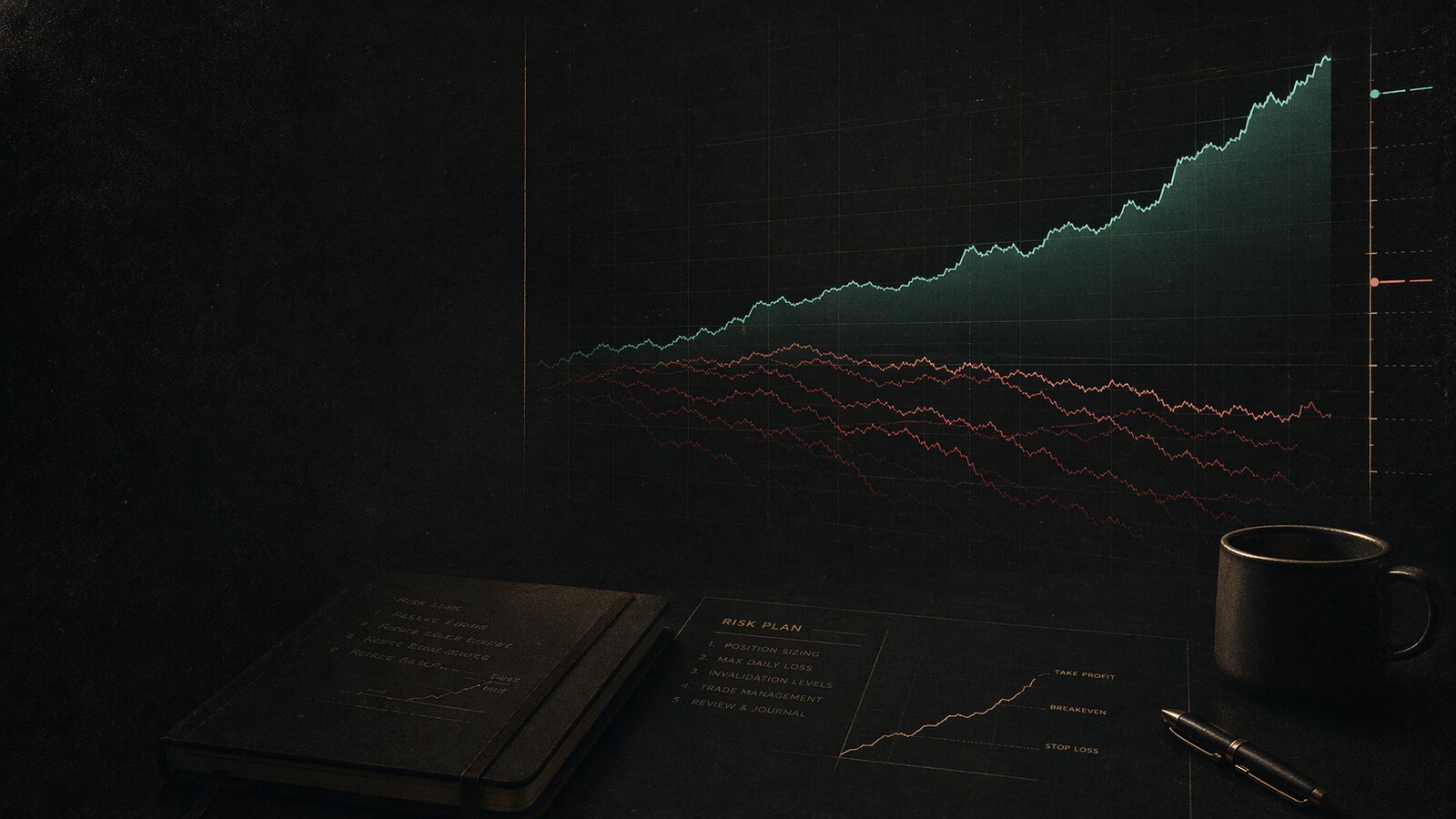
Here’s a statistic that doesn’t make it onto signal group landing pages:
Roughly 90-95% of retail crypto traders lose money over any meaningful time window. The exact number varies by study, asset class, and definition of “losing” — but the broad range holds across data from exchanges, academic research, and regulatory reports.
This isn’t a secret. It’s also not bearish doom-posting. It’s a description of reality. And the interesting question isn’t whether 95% of traders lose. The interesting question is: why?
Because if the failure rate were random — if it were purely a function of market unpredictability — then winning and losing would be 50/50, not 5/95. The 95% failure rate implies something systematic. Something the losers are doing that the winners aren’t. Or something the losers believe that the winners don’t.
This article breaks down the five structural reasons most crypto traders lose money, and the five habits the surviving 5% consistently share. Many of these patterns apply beyond crypto — they’re behavioral finance insights rediscovered in every speculative market since tulip bulbs. But the crypto environment intensifies them to a point where the casualty rate is visible to the naked eye.
If you’re currently trading crypto or considering it, this is the frank article you need to read before anything else.
⚠️ Disclaimer upfront: This article is educational content. Nothing here is financial, psychological, or career advice. Crypto trading carries substantial risk of loss including total loss of capital. If you’re experiencing financial or emotional distress from trading, please stop trading and consult a qualified professional.
§1 — The Numbers (What the Data Actually Says)
Before diagnosing causes, let’s anchor on the data.
The academic studies
Multiple peer-reviewed studies on retail trader performance, across forex, stocks, and crypto, converge on similar conclusions:
- A widely-cited Brazilian study on day traders found over 90% lost money after 300+ trading days, with only a tiny fraction producing professionally meaningful returns
- Exchange-leaked data from several jurisdictions has shown retail CFD trader loss rates consistently in the 70-85% range
- Crypto-specific research has documented addiction-like behaviors, compulsive trading even through losses, and strong social-media-driven herd behavior in roughly 60-70% of active participants
The exact percentages vary. The direction doesn’t: most retail speculators lose money, most of the time, in most markets, with the severity compounded in crypto by leverage availability and 24/7 operation.
The “95%” figure specifically
The “95% of crypto traders lose money” claim is commonly cited but rarely sourced rigorously. Treat it as directionally accurate rather than precise:
- It’s almost certainly above 80%
- It’s almost certainly below 99%
- Somewhere in the 85-95% range for meaningful sample sizes over 6+ months is probably correct
- The number depends heavily on how you define losing (measured vs S&P 500 benchmark? vs inflation? vs simply holding BTC?)
For this article, we’ll use “95% lose” as a rhetorical anchor while acknowledging the actual figure is probably somewhere in that band.
What this means for you as an individual
Statistical aggregates do not determine individual outcomes. Just because 95% of traders lose doesn’t mean you will lose — but it should inform how you approach the activity.
Think of it this way: if 95% of people starting a new restaurant go out of business within 5 years (roughly accurate), a thoughtful person starting a restaurant doesn’t give up — but they do take the statistic seriously and study the 5% who survive. What did they do differently? What should I learn from them before I commit?
The same approach applies to crypto trading. The 95% who lose aren’t lying about wanting to win. They’re doing something systematically different from the 5% who survive. Let’s find out what.
§2 — Loss Driver #1: Unsustainable Position Sizing
The single biggest cause of trader failure.
Most retail traders size positions based on emotion, account size, or “how confident they feel.” Almost none size based on the mathematical survival constraints of speculative trading.
What losers do
- Put 10-50% of their account on a single “high conviction” trade
- Use 20x-100x leverage because “more leverage = more profit”
- Size up after losses to “recover faster”
- Size up after wins because “I’ve got momentum”
- Have no consistent formula for position sizing
- Don’t calculate risk in dollar terms before entering a trade
Why this kills accounts
The math of drawdowns is brutally asymmetric. Losing 50% requires gaining 100% to recover. Losing 70% requires 233% to recover. Losing 90% requires 900% to recover.
A trader sized correctly (1% risk per trade) can survive 20 consecutive losses and be down 18% — bad but survivable. A trader sized at 10% can lose 7 times in a row and be down 52% — effectively unrecoverable in any reasonable timeframe.
Given that every trading system, including the best ones, experiences 5-10 trade losing streaks regularly, oversized traders are statistically guaranteed to blow up. Not possibly. Necessarily.
What the 5% do
- Risk 1-2% of account per trade, no exceptions
- Size down after losing streaks (never up)
- Use leverage as a margin efficiency tool, not a profit multiplier
- Calculate dollar risk before entering every single trade
- Have the discipline to take small sizes even when confidence is high
The math is simple. The execution requires resisting every impulse your brain generates after seeing a “sure thing” setup. That resistance is what survives.
§3 — Loss Driver #2: No Stop-Loss Discipline
The second biggest cause of failure.
Stop-losses are the difference between losses that heal and losses that compound. And most losing traders systematically avoid them.
What losers do
- Don’t set stop-losses at all (“I’ll close it manually if things get bad”)
- Set stop-losses mentally but don’t place them on the exchange
- Move stop-losses further away when price approaches them
- Cancel stop-losses because “I believe in this trade”
- Use stops that are so tight they get triggered by normal noise
- Use stops that are so wide the trade has no defined invalidation
Why this kills accounts
Stops exist because humans cannot reliably execute trade invalidation under emotional stress. In calm conditions, you agree a trade is wrong at a certain level. Under stress at that level, you find reasons to keep it open. “It’s just a wick.” “It’ll bounce.” “The candle hasn’t closed.”
Every inch you give a losing position is capital you’re bleeding. Without a pre-committed mechanical exit, your losses are uncapped — not in theory, in practice. Traders who “let runners run” on losing positions turn small controlled losses into account-ending catastrophes every single cycle.
What the 5% do
- Set stop-losses on the exchange before stepping away from the trade
- Never move stops in the wrong direction (farther from entry)
- Only trail stops in favor of the position (tighter as it runs profitable)
- Place stops at levels that respect asset volatility (ATR-based, not arbitrary)
- Accept that some stops will get hit on noise and still stick to the rule
The 5% understand that a stopped-out trade isn’t a failure — it’s working as designed. Stop-losses are not about winning every trade; they’re about making sure losses are recoverable.
§4 — Loss Driver #3: Emotional Trading Under Stress
The universal human problem, amplified by crypto’s unique environment.
What losers do
- Revenge-trade after losses to “make it back”
- FOMO-enter pumping assets near tops
- Panic-close winning positions before planned targets
- Over-trade during drawdowns, looking for the “one good trade” to fix things
- Take trades while tired, drunk, caffeinated, stressed, or angry
- Check charts obsessively during losing positions
- Believe they’re immune to the emotional biases they’ve read about
Why this kills accounts
Trading is a cognitive task. The human brain’s decision-making quality is dramatically degraded under stress. Fatigue reduces judgment to roughly the equivalent of being mildly intoxicated. Strong emotions (fear, anger, excitement) shut down the prefrontal cortex in favor of the amygdala’s fight-or-flight response.
This means: the exact moments when you most want to trade — during a drawdown, after a big win, during a pumping market — are the moments when your decision-making is worst. The 95% trade more during these moments. The 5% trade less.
Crypto intensifies this because:
- 24/7 markets mean there’s always an “opportunity” to obsess over
- Social media amplifies emotional contagion (everyone else is panicking or euphoric)
- Leverage makes emotional decisions instantly catastrophic
- No circuit breakers (stocks get paused during extreme moves; crypto doesn’t)
What the 5% do
- Define specific trading hours and stick to them
- Take mandatory breaks after losses (1 hour minimum, often the rest of the day)
- Don’t trade when emotionally compromised (hungry, tired, angry, euphoric)
- Use mechanized execution (pre-placed stop-losses and TPs) to remove real-time decisions
- Keep trading separate from their emotional life
- Accept that they’re human and vulnerable, and build systems that account for it
The critical insight: willpower fails. The 5% don’t rely on willpower. They rely on structure that makes bad decisions mechanically harder.
§5 — Loss Driver #4: No Edge, Or No Awareness of Edge
The silent account-killer.
“Edge” in trading means: a statistically reliable reason your trading approach should produce positive expected value over time. Without edge, you’re flipping biased coins — and the fees, spreads, and emotional leakage ensure the bias goes against you.
What losers do
- Trade without articulating why they expect to make money
- Copy random strategies from YouTube without testing
- Believe “I read charts well” is a sufficient edge
- Chase whichever strategy was profitable last month
- Use technical indicators without understanding why they’d work
- Pay for signal services without verifying the signals actually work
- Confuse confidence with edge
Why this kills accounts
Every trade has costs: exchange fees (~0.02-0.1% per side), spread (~0.01-0.05%), slippage (~0.05-0.2%), funding rates (for perpetuals). These add up to roughly 0.3-0.8% round-trip per trade.
To make money, your raw strategy needs to produce returns that exceed these costs, after accounting for variance. “Break even” isn’t a viable goal because the costs slowly bleed you.
Without a genuine edge, the math of cumulative trading fees guarantees negative returns over time — even before emotional mistakes. Traders who don’t know why their strategy should work are mathematically guaranteed to lose, just on a longer timeline than those with bad discipline.
What the 5% do
- Can articulate in one sentence why their strategy should produce positive expected value
- Test strategies on paper or with micro-size before committing capital
- Track their actual performance and compare it to expectations
- Accept that “edge” is real but modest — not 90% winrates, but small sustainable advantages
- Either develop their own edge through years of study, or rent it from a reliable source (mentors, signal services with verifiable track records) and follow it disciplined
The 5% also understand that edge decays. A profitable strategy from 2020 may not work in 2026. Continuous evaluation is part of the job.
§6 — Loss Driver #5: Trading With Money That Matters
Almost nobody wants to admit this one, but it’s one of the biggest separators.
What losers do
- Fund accounts with rent money, emergency savings, or borrowed funds
- Leverage their retirement accounts
- Tell themselves “I’ll just trade a small amount” and then slowly increase
- Feel life-altering stress on every trade
- Need trading profits to pay bills
- Use credit cards or personal loans to fund trading
Why this kills accounts
When the money matters too much, every single decision is distorted by fear. You can’t set stops appropriately because you can’t afford to take the loss. You can’t let winners run because you need the profit now. You can’t step away after losses because you need to recover. You can’t think clearly because your nervous system is in survival mode every minute of the day.
It’s not weakness — it’s biology. High-stakes decisions trigger physiological stress responses that degrade judgment. Professional institutional traders have this problem too, which is why they use risk committees, position limits, and external oversight to structurally reduce stress-driven decisions.
Retail traders have no such structure. If the money matters, the stress will overwhelm the process every single time.
What the 5% do
- Only trade with money they can afford to lose completely
- Keep trading accounts small relative to total net worth (often under 10%)
- Have separate emergency funds that trading drawdowns can’t touch
- Maintain income from non-trading sources
- View trading as a long-term skill-building exercise, not an income source
- Scale up account size only as skill and track record justify it
The 5% also understand that “money you can afford to lose” doesn’t mean “money you want to lose.” It means money whose loss wouldn’t alter your life circumstances, relationships, or mental health.
If losing your current trading capital would ruin your month, the amount is too large.
§7 — The Positive Frame: The 5 Habits of Survivors
Same ideas, reframed as what to do instead of what to avoid.
Habit 1: Position sizing as a non-negotiable
Every single trade, calculated the same way: 1% of account at risk. No exceptions based on feel, conviction, recent outcomes, or market conditions. The math is done the same way every time: divide risk budget ($10 for $1000 account) by distance to stop-loss as % to get notional size.
This habit alone eliminates 70% of the failure modes described above.
Habit 2: Mechanical stop-losses on every position
Every trade, every time: stop-loss placed on the exchange before stepping away. No mental stops. No “I’ll watch it.” Only the exchange can be trusted to execute under stress; your brain cannot.
Never move the stop wider. Only tighter, and only after the trade is already in profit. These rules are absolute.
Habit 3: Structured trading hours and mandatory breaks
Defined start and stop times for trading activity. Discord/Telegram notifications muted outside those hours. After significant losses or wins, mandatory 1-hour breaks (or full-day breaks for larger events).
The survivor’s trading day looks boring and routine. The 95%‘s trading day looks like an emotional rollercoaster. The boring version is the correct one.
Habit 4: Documented edge or rented edge
Either:
- Develop your own edge through 1-3+ years of deliberate study, paper trading, and gradual scale-up
- Rent edge by following a signal service with verifiable track record, at appropriate size, with full execution discipline
Never trade without answering the question: “Why should I expect this to produce positive expected value over time?” If you can’t answer, don’t trade that setup.
Habit 5: Account capitalization that doesn’t require success
Fund your trading account with money whose loss would not meaningfully harm your life. Keep trading as a modest portion of net worth. Don’t need trading to pay bills.
This single habit resolves a disproportionate amount of psychological damage. When the money matters less, the decisions get better. When the decisions get better, the money grows. Paradoxically, traders who don’t need to make money often end up making more of it than those who do.
§8 — The Honest Role of Signal Services
Since this is an Ascendant Traders blog, let’s address the elephant.
A signal service is a form of “rented edge” — you’re paying someone else to generate trade setups that should have positive expected value.
This works if:
- The provider actually has edge (verifiable track record, transparent methodology, honest winrate reporting)
- You execute their signals with discipline (position sizing, stop-loss adherence, no modifications)
- You avoid the five loss drivers above independently of the signal quality
It doesn’t work if:
- The provider is fake or scammy (no real edge, marketing fraud)
- You follow them but don’t execute disciplined sizing
- You “improve” their signals by modifying entries, stops, or targets
- You treat signal wins as guaranteed income
We’ve written extensively elsewhere about how to evaluate a signal service (see our articles on winrate math and signal-reading fundamentals). What matters for this article: renting edge is not a shortcut around discipline. You still have to size correctly, set stops, manage emotions, and deploy money you can afford to lose. The signal service provides the analysis; you provide everything else.
Most signal subscribers who lose money don’t lose because the signals were bad. They lose because they had bad discipline. Moving up the edge ladder (better signals, better providers) doesn’t help if the discipline layer stays broken.
The 5% who make money following signals do so because they’re already in the 5% on discipline. The signal service is amplifying an existing behavioral advantage, not creating one from scratch.
§9 — The Meta-Point: Most People Don’t Want to Hear This
The uncomfortable truth about the 95% failure rate:
Most of the people losing money could be in the 5% if they wanted to. The habits aren’t secret. They aren’t even complicated. Size at 1%. Set stops. Take breaks. Trade with money that doesn’t matter. Find or rent edge.
Why don’t they?
Because the 5% habits are boring. They cap upside during pumps. They force uncomfortable discipline during drawdowns. They require patience and humility. They turn trading from an exciting emotional activity into a routine maintenance process.
Most retail traders don’t actually want to make slow, reliable returns. They want the thrill. They want to be right. They want to tell stories about 10x wins. They want to out-smart the market.
These desires are human. They’re also structurally incompatible with long-term profitability. You can have one or the other — not both.
The 5% have made peace with boring. The 95% keep chasing excitement. The casualty count reflects the choice.
§10 — The Path For People Who Want to Be in the 5%
If you’ve read this far and still want to trade, here’s the practical sequence.
Step 1: Accept the base rate.
You’re statistically likely to lose money as a new trader. That’s the starting assumption. Your job is to beat the base rate by doing specific things differently. If you approach trading assuming you’ll be a natural winner, you’ll make the choices that produce natural losers.
Step 2: Commit to paper trading or micro-trading for 90 days.
Before you risk meaningful capital, run the full system (signal service + your execution + journaling) with either zero or tiny stakes. You need to experience the execution grind before the stakes rise. Most people skip this step. Most people lose.
Step 3: Install the five habits mechanically.
Write them down. Calculate position sizes on a spreadsheet. Set stops on every trade. Block trading hours. Fund with money that doesn’t matter. Document why you expect to make money.
Step 4: Journal every trade.
Not optional. 10 minutes total per day. The data compounds.
Step 5: Review weekly. Adjust rarely.
Most weeks should produce zero strategy changes. Adjustments happen monthly or quarterly, based on data, not gut.
Step 6: Expect to be unprofitable for 3-6 months.
Even if you execute well. Variance dominates small samples. The data means nothing until you have 100+ trades. Patience is part of the edge.
Step 7: Evaluate honestly at 6 months.
Are you flat or slightly profitable? Continue. Scale modestly. Keep the discipline. Are you significantly negative despite disciplined execution? The strategy (or provider) isn’t working for you. Investigate honestly. Consider switching approaches. Don’t doubling down.
Step 8: Build the habits to last decades, not months.
Most 5% survivors have been trading 3-10+ years. Their first year or two wasn’t impressive. Their compound edge came from persistent execution over a long horizon. Plan accordingly.
Frequently Asked Questions
Is the 95% failure rate really accurate?
Directionally yes; precisely, probably 85-95% depending on definition and time window. Treat it as “most retail crypto traders lose money most of the time” — the exact digit matters less than the structural fact.
Can someone become profitable in their first year?
A small fraction, yes. A larger fraction appears profitable in year one due to luck, then gives it back in year two. Sustainable profitability almost always takes 2+ years of committed effort.
Is trading gambling?
Without edge and discipline: yes, unambiguously. With both: no, it’s a skill-based activity with statistical expectation, closer to professional poker than slot machines. The difference is entirely about whether you’ve built the edge + discipline structure.
Should I just buy and hold instead?
For most people, yes. Dollar-cost-averaging into BTC/ETH over 5+ years has historically outperformed the average active trader. Active trading only makes sense if you’re genuinely in (or striving for) the 5% — and even then, holding is often the smarter core strategy.
How do I know if I’m in the 5% or the 95% early on?
You don’t. Samples under 50 trades are noise. The only reliable indicator is long-term execution quality, visible in your trading journal after 6+ months. Everyone thinks they’re in the 5% before they have evidence.
Does using a signal service mean I’m cheating or shortcutting?
No. Renting edge is a legitimate approach — it’s what institutional investors do with fund managers. The shortcut illusion only applies if you think signal subscription = passive income. It’s not. You still need to execute disciplined sizing, stops, and psychology — the same five habits that determine outcome regardless of signal source.
Final Takeaway
The 95% failure rate isn’t a curse. It’s a description of what happens when humans with normal biology apply normal heuristics to a speculative market that punishes normal heuristics.
The 5% who survive aren’t smarter. They’re not luckier. They’re not genetically superior. They just do five specific things consistently:
- Size positions for survival, not thrill
- Set mechanical stop-losses and don’t move them
- Trade during structured hours with mandatory breaks
- Trade with edge (own or rented) they can articulate
- Use money whose loss wouldn’t hurt them
None of these habits is individually impressive. Combined and sustained over years, they produce outcomes that 95% of traders envy and can’t replicate.
The math is boring. The discipline is hard. The outcomes are asymmetric.
If you want to be in the 5%, you don’t need more signals, more indicators, or more leverage. You need the habits above, executed every day for years, through every emotional state, regardless of what the market is doing.
Most people won’t do this. That’s why it works.
The question is whether you will.
⚠️ Reminder: This article is educational content only. Nothing in it is financial, psychological, or career advice. Crypto trading carries substantial risk of loss including total loss of capital. If trading is causing meaningful financial or psychological distress, please stop trading and seek qualified professional guidance.
Ready to start with rented edge and disciplined execution?
Join the free Ascendant Traders Discord → discord.gg/fcPV99aD9z
The signals are transparent — and free. The discipline is on you.